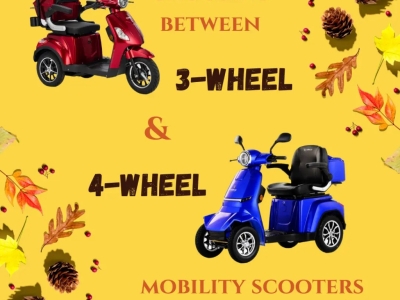
If you're a heavier user looking for the perfect mobility scooter, you've probably wondered whether a 3-wheel or 4-wheel model is right for you. Here is some good news for you – you are in the right place as in this article we dive into the world of
mobility scooters for heavier users and help you make the best choice for your needs!
Table of Contents:
- Understanding the basics: 3-wheel vs 4-wheel mobility scooters
- Which one's better: 3- or 4-wheeled mobility scooter?
- Weight capacity considerations for heavy users
- Stability and safety: which option wins?
- Safety features: the unsung heroes
- 3-wheel and 4-wheel mobility scooters for heavier users – making the right choice
Understanding the basics: 3-wheel vs 4-wheel mobility scooters
When it comes to mobility scooters, the number of wheels can make a world of difference. But what exactly sets 3-wheel and 4-wheel scooters apart?
What's the deal with 3-wheel scooters?
Picture a tricycle for adults, but with a comfy seat and a motor. That's essentially what a 3-wheel mobility scooter is. These nifty little machines have one wheel at the front and two at the back, forming a triangle shape.
3-wheel scooters are known for their:
- Manoeuvrability – They can turn on a sixpence, making them ideal for riding tight spaces.
- Lightweight design – Generally easier to transport and store.
- Compact size – Perfect for zipping around indoor spaces.
But what about 4-wheel scooters?
Now, imagine a miniature car with four wheels – that's your 4-wheel mobility scooter. These sturdy chaps have two wheels at the front and two at the back, providing a more stable base.
4-wheel scooters are celebrated for their:
- Stability – The extra wheel means better balance for inexperienced users, especially on uneven terrain.
- Higher weight capacity – Generally able to support heavier users.
- Smooth ride – The four-wheel design often provides better shock absorption.
So, which one's better: 3- or 4-wheeled mobility scooter?
Well, that's like asking whether tea or coffee is better – it depends on your personal taste and needs!
For instance, if you're planning to use your scooter
mainly indoors or in tight spaces, a 3-wheel model might be your cup of tea. Mrs. Thompson, a sprightly 70-year-old from Brighton, swears by her 3-wheel scooter for riding the narrow aisles of her local Tesco.
On the flip side, if you're after a sturdy ride for outdoor adventures, a 4-wheel scooter might be more your speed. One of our clients, a retired postman from Leeds, loves taking his
4-wheel scooter for a spin in the local park, come rain or shine.
The bottom line? Both types have their strengths and weaknesses. The key is to match the scooter to your lifestyle and needs. But
what about weight capacity? After all, that's why you're here, isn't it? Well, hold onto your hats, because we're about to dive into that very topic in the next section.
Weight capacity considerations for heavy users
When it comes to mobility scooters for heavier users, weight capacity is the elephant in the room! It's not just about whether the scooter can support your weight; it's about how well it performs while doing so.
How much is too much?
First things first, let's talk numbers. Generally speaking,
3-wheel scooters have a lower weight capacity compared to their 4-wheel counterparts. But don't let that fool you – there's more to this story than meets the eye.
- 3-wheel scooters: Typically support 250-350 lbs (113-159 kg)
- 4-wheel scooters: Often accommodate 300-500 lbs (136-227 kg)
Why does weight capacity matter?
You might be thinking, "As long as I'm under the limit, I'm golden, right?" Well, not quite. Weight capacity affects more than just whether the scooter will move or not. It impacts:
- Battery life – The heavier the load, the harder the motor works, which can drain the battery faster.
- Speed – A scooter at its weight limit might not reach its top speed.
- Comfort – Suspension systems work best when not pushed to their limits.
The Goldilocks zone
Ideally, you want a scooter with a weight capacity that's "just right" – not too close to your actual weight, but not unnecessarily high either. A good rule of thumb is to choose a scooter with a
weight capacity at least 25% higher than your actual weight.
For example, if you weigh 300 lbs (136 kg), aim for a scooter with a weight capacity of at least 375 lbs (170 kg). This gives you some wiggle room for those days when you're carrying shopping or wearing heavier clothes.
Stability and safety: which option wins?
When it comes to mobility scooters, stability and safety are like tea and biscuits – you simply can't have one without the other. But which option, 3-wheel or 4-wheel, takes the biscuit in this department? Well, let's find out!
The great stability showdown
At first glance, you might think 4-wheel scooters would win hands down in the stability stakes. After all, four wheels are better than three, right? Well, it's not quite that simple.
- 3-wheel scooters: These zippy little numbers offer decent stability on flat surfaces and are less likely to tip forwards or backwards.
- 4-wheel scooters: With their wider stance, these sturdy chaps provide better side-to-side stability, making them less prone to tipping sideways.
But here's the rub –
stability isn't just about the number of wheels. It's about weight distribution, centre of gravity, and how you use the scooter.
Safety features: the unsung heroes
Now, let's talk about the bells and whistles that keep you safe:
- Anti-tip wheels: These little lifesavers on both 4- and 3-wheel models provide extra stability on uneven terrain.
- Speed control: Both types often come with adjustable speed settings.
- Electromagnetic brakes: These nifty devices automatically engage when you release the throttle, ensuring you stop safely.
Terrain troubles: where the rubber meets the road
The type of terrain you'll be tackling plays a big role in which scooter is safer for you.
Both 3-wheel and 4-wheel mobility scooters
perform well on flat, even surfaces. It's a tie! When it comes to uneven terrain, 4-wheel scooters generally have the edge here. Their wider wheelbase provides better stability on bumpy paths or grassy areas.
The human factor
Let's not forget – safety isn't just about the scooter, it's about how you use it. We like to say that the safest scooter is the one you're most comfortable driving. So, which option wins?
In the stability and safety arena, 4-wheel scooters generally have a slight edge, especially for heavier users or those tackling varied terrain. However, 3-wheel scooters can be
perfectly safe when used appropriately and can offer advantages in certain situations.
The bottom line? Choose the option that makes you feel most secure and suits your lifestyle. After all, the best mobility scooter is the one that gets you out and about with confidence!
3-wheel and 4-wheel mobility scooters for heavier users – making the right choice
So, there you have it - the lowdown on choosing between 3-wheel and 4-wheel mobility scooters for heavier users. We've covered everything from weight capacity and safety features to stability. But what's the verdict?
Well, as much as we'd love to give you a clear-cut answer, the truth is, there's no one-size-fits-all solution. The best scooter for you depends on
your individual needs, lifestyle, and preferences.
- If you prioritise manoeuvrability and compact storage, a 3-wheel scooter might be your cup of tea.
- If stability and outdoor performance are top of your list, a 4-wheel model could be just the ticket.
Remember, the goal is to find a scooter that enhances your independence and quality of life. Don't be afraid to
take a few models for a spin before making your decision. After all, you wouldn't buy a pair of shoes without trying them on first, would you?
And if you're still feeling a bit stuck, why not
chat with our mobility expert? They can help you consider the options and find the perfect match for you.
So, whether you end up cruising on three wheels or four, here's to finding a scooter that gets you where you want to go – in comfort, style, and with a big smile on your face. Happy scooting!